
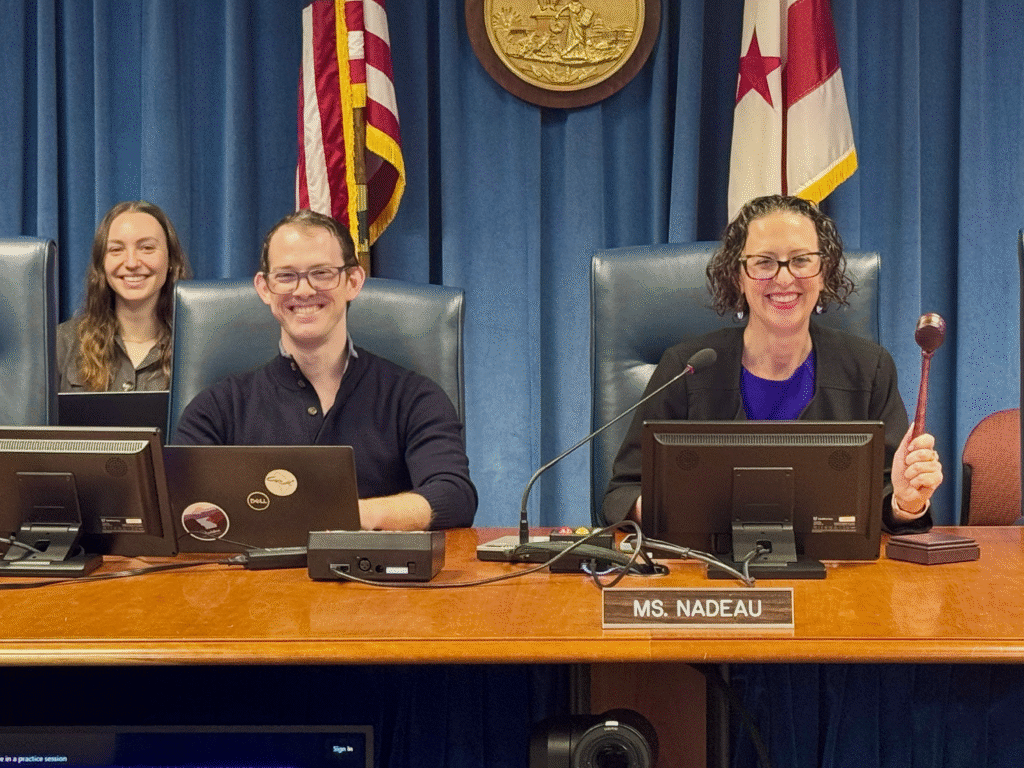
Last Thursday the Committee on Public Works & Operations, which I chair, held its last meeting of the Council Period. We marked up five bills and sent them to the full Council for votes next month.
Like a lot of the work of this committee, these bills represent the kind of wonky, in-the-weeds attention to boring but critical details of how government runs that we deal with all the time. Of course, we’ve dealt with a lot of high-profile legislation, too, like finding ways to hold dangerous drivers accountable, clarifying laws so that rogue ride-hailing companies can’t pretend that’s not what they are, and finding ways to expand and improve waste diversion efforts like recycling and composting.
A big thank you to my Committee staff and legislative director for keeping their nerd hats on and making city government work better – even the stuff that doesn’t get the limelight.
Here are highlights from last week’s markup:
A better sidewalk vending system, finally
The committee unanimously approved my Vending Modernization Act, which would require the Department of Licensing and Consumer Protection to fully implement legislation I passed in 2023 to organize sidewalk vending across the District, especially in Columbia Heights.
The bill gives DLCP stronger impoundment and seizure authority – a process for seizing property under some circumstances, such as when they are unable to identify the vendor. This targets the actual mechanism of vending and is in line with DLCP enforcement of brick-and-mortar businesses, instead of instituting harsh, unfair, and ineffective criminal penalties.
To be clear, the bill does not implement any criminal penalties for vending and doesn’t grant MPD authority to enforce vending authorization requirements. This does not stop MPD from taking action regarding any activity that is currently a criminal violation, and we have explicitly stated that in this bill – crimes are crimes under current law and under this bill.
The bill also addresses remaining barriers to licensure for vendors, including lowering the quarterly minimum sales tax for sidewalk vendors and requiring District agencies to streamline the licensure process. It also distinguishes between sidewalk vending and food trucks, providing for different enforcement mechanisms for each.
Better enforcement of short-term rentals
In 2018, the Council passed rules to regulate short-term rentals in the District after seeing their impact on the local housing stock. However, enforcement of this law takes considerable resources and DLCP has been unable to keep up, leading to thousands of unauthorized short-term rentals available for rent at any moment in the District. That’s bad for safety and contributes to driving up the cost of housing for everyone.
One of the most significant elements of legislation the Committee approved last week is that it moves us from a system where DLCP has to chase down every violator and engage in a months-long process, only to have the rental owner list the property again, to a system where booking services like Airbnb and VRBO must verify that a property has a valid license before the rental is listed.
We know the system can work because it already does. Cities who have moved to this platform-verification model, like New York City and LA, have seen their short-term rental listings drop by 50 to 90 percent.
The bill also allows renters to host short-term rentals – only if the property owner gives permission, of course.
The rest
We also advanced legislation to better regulate ride-hailing services in the District, especially by clarifying what activities are subject to regulation by the Department of For-Hire Vehicles, to counter efforts by companies attempting to skirt the law.
We passed legislation to help promote hospitality businesses while also protecting their workers.
And we approved changes to establish clear rules and rights to safeguard individuals’ data, promoting responsible data usage so that our government can continue to utilize data-informed service delivery for District residents and visitors.
All of these bills will go to the full Council for votes on December 1 and 15.