
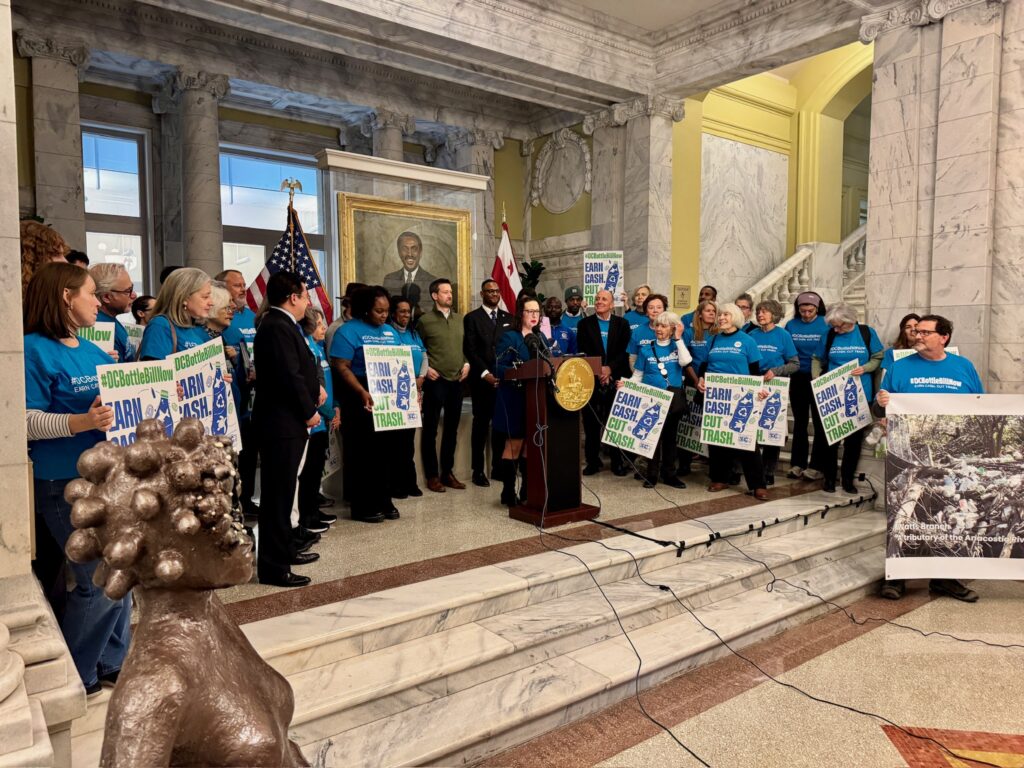
D.C.’s bottle bill will drastically reduce litter on our streets and in our neighborhoods, parks, and rivers.
The Recycling Refund and Litter Reduction Amendment Act of 2025 is major environmental legislation that would drastically reduce litter in streets, parks and rivers. It establishes a bottle and can deposit-refund program in which consumers make a 10-cent deposit on beverages and are refunded that deposit when they return the empty bottles and cans to be recycled – meaning it does not add to the cost of a beverage, as shown in the 10 states that have the program. The program, which would be managed by beverage distributors, would be overseen and enforced by the Department of Energy and the Environment.
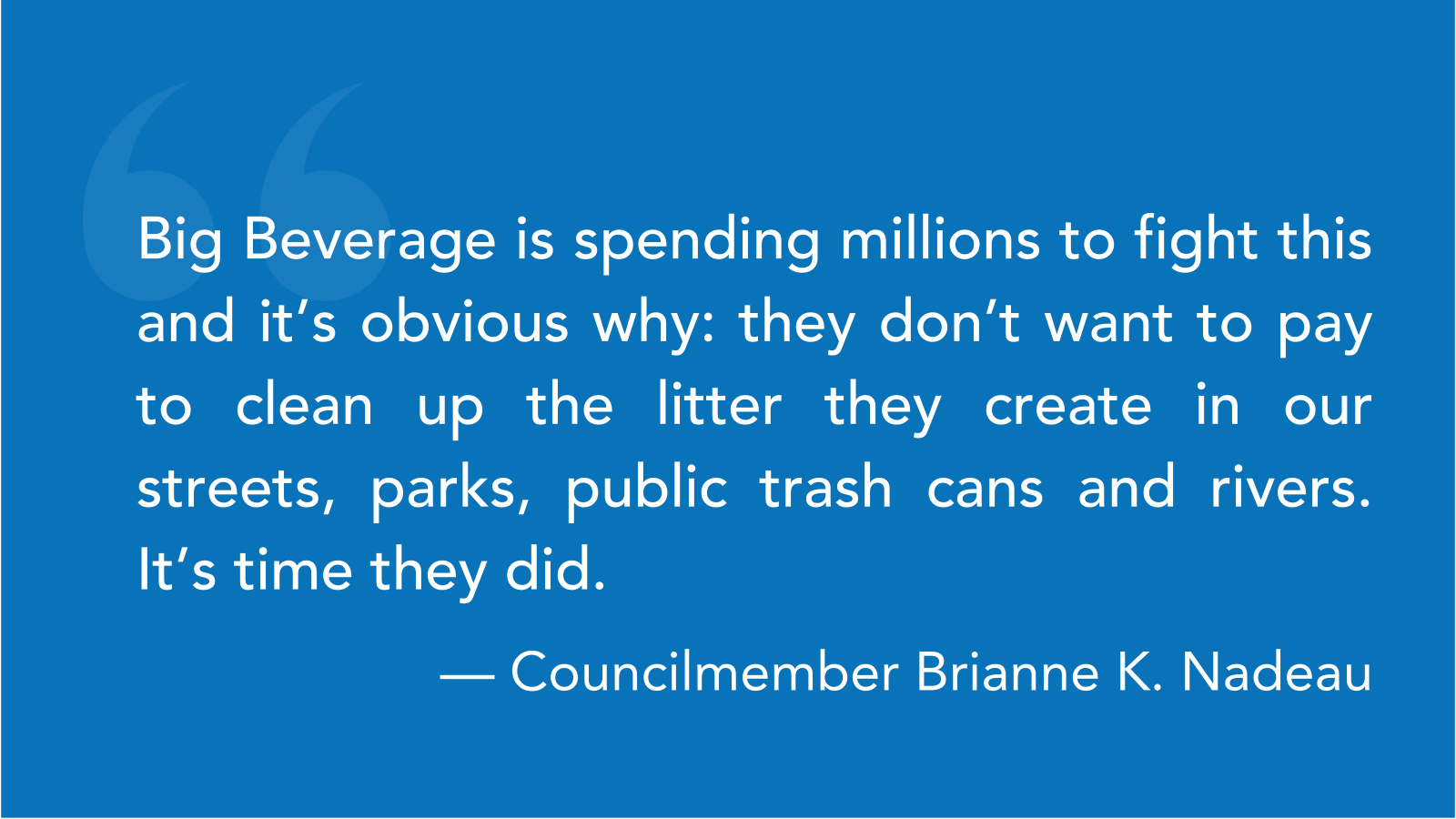
Councilmember Nadeau introduced the legislation in January 2025, with Council Chairman Phil Mendelson and nine other councilmembers joining as co-introducers.
Read the text of the bill as it was introduced.
The District of Columbia has a significant litter issue. Beverage containers – bottles and cans – accumulate on streets and sidewalks and in and around overflowing public trash cans. Plastic bottles alone account for 60 percent of the weight of all trash retrieved from the Anacostia River. A large percentage of the containers that do make it into recycling or trash bins end up going to landfill rather than getting recycled.
The 10 states that have implemented similar programs saw significant and rapid reductions in bottles and cans in the waste stream, because residents, visitors, and “canners” – people who collect bottles and cans to redeem them –are incentivized to redeem their containers. In Michigan, the return rate for bottles is 73 percent. In Maine, it’s 77 percent. According to the Container Recycling Institute, the District only recycles 24% of beverage containers.
The District’s bottle refund bill is projected to increase recycling rates by more than three times and cut wasted containers – those that end up in the incinerator, landfill, or the environment – by five times.
Life cycle of the beverage container deposit
The path of the 10-cent deposit is circular: first it’s charged to the retailer, who then charges it to the customer, who gets it back from the retailer or redemption center when they return the empty container, which gets it back from the distributor.
After redeeming their containers, beverages cost nothing more to the customer than they did before. (And evidence in all 10 states with bottle refund systems shows this to be the case.)
Impact on businesses
Very small retailers with less than 2,000 square feet of display space are not required to collect/redeem containers. But they can – and they would earn money for doing it.
Hotels, restaurants, bars and event venues that serve beverages on premises are not required to charge, collect, or reimburse deposits.
What’s next?
The Committee on Transportation and the Environment will vote on a a “markup” version (“committee print) and then it will go to the full Council for votes in December.
Frequently Asked Questions
What beverage containers will require deposits?
The bill would require deposits to recycle glass and plastic bottles and aluminum cans, from 50 milliliters (1.7 ounces) to three liters (just over three quarts). Dairy, infant formula, and medications are excluded.
Pouches and cartons are not included because there are no recycling markets for them.
How do customers get their deposit back in cash?
Customers return their empty bottles to the same store where they bought it, a redemption center, or a reverse vending machine.
Small retailers are not required to accept “empties” but may choose to because they would receive a handling fee for every container. The legislation requires the beverage industry to ensure there are convenient places to return containers in every part of the District.
In states with bottle refund programs, school groups, churches, and others collect empty containers and redeem them for cash to support their work.
How do people get money back from a reverse vending machine (RVM) or redemption center?
The reverse vending machine will print a ticket for a deposit return which people can bring into the store for a cash refund or to use as a credit if making a purchase. Redemption centers will issue a cash refund or immediately credit the refund to an individual’s redemption account. Retailers may refund deposits directly to customers redeeming containers in their stores.
How will this impact the cost of beverages?
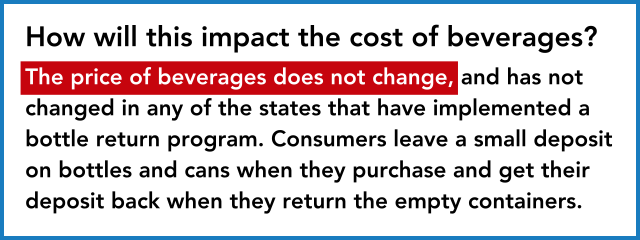
The price of the beverage does not change, as has been seen in every state that’s implemented similar programs.
Retailers will collect an additional 10-cent deposit from customers, who then get their 10 cents back when they return the empty container. Experience in other states with bottle bills shows that manufacturers and distributors do not increase the price on their products when a bottle bill is implemented.
How do entrepreneurs benefit?
In every jurisdiction with a bottle refund system, a small industry of entrepreneurs who collect bottles and cans arises. They have an incentive to contribute to beautifying our public spaces because they get money for the containers they collect, and it creates income opportunity for individuals, especially some whose earning options are limited.
The programs also create a small ecosystem of entrepreneurs who collect from businesses and open redemption centers. These are facilitated by the four-cent per container handling fee that’s covered by the big beverage industry, making it worth their while.
How does the deposit return system work on the retailer end?
Retailers get paid a four-cent handling fee for every bottle and can they take back by a nonprofit “beverage stewardship organization” set up and paid for by beverage distributors. Participating retailers would be required to accept beverage containers any time their business is open. They’d be required to accept any beverage container of the same types sold at the establishment, regardless of whether the container was actually sold there.
Retailers can accept beverage containers for redemption through a direct take-back, a bag drop program, or through reverse vending machines.
How will the bill impact mom & pop stores?
Stores with under 2,000 square feet of retail space are exempted from the requirement to redeem beverage containers. Mom & pop stores can opt-in if they want and may find it beneficial as they would receive the per-container handling fee and accepting returns is a selling point for consumers. DOEE is authorized to set a minimum number of return locations in underserved areas to ensure that it’s convenient for everyone to return their containers and get their deposit back.
How will the bill impact liquor stores?
Stores with less than 2,000 square feet of retail space are exempted from the requirement to take back empty bottles and cans.
Are there any circumstances under which a retailer would not be required to accept a beverage container?
Yes. If the container is not clean, is broken, contains unexpected materials in it, or if the retailer believes it was not sold in the District.
Will there be enough places to redeem in all parts of the city?
Yes. The bill requires the nonprofit beverage stewardship organization set up by the distributors to develop a plan that includes a sufficient number of redemption locations throughout the city and DOEE has the ability to direct the nonprofit to add locations to meet the need.
What happens to unredeemed deposits?
The beverage container stewardship organization transfers 75% of all unredeemed deposits to a District Recycling Fund. The beverage container stewardship organization retains 25% of unredeemed deposits to cover their costs of administering the program.
What is the District Recycling Fund?
The Fund is used to pay for:
-
- The cost to the District of implementing and oversight;
-
- Providing water filters to low-income residents whose lead service lines have not been replaced;
-
- Installing reverse vending machines (RVM’s);
-
- Installing water bottle refill stations in public spaces in the District; and
-
- Other programs to increase beverage container reuse and refill in the District.
Will this impact sales figures for retailers and beverage companies?
The Container Recycling Institute (CRI) and the Reloop Platform studied the issue and found no evidence that bottle refund bills result in lost sales to beverage companies. Big beverage has produced no evidence that programs raise the price of beverages.
How is this expected to affect the District’s rate of recycling?
The Container Recycling Institute projects that the bill will lead to an 85% recycling rate for beverage containers, up from 24% currently. That means 524.5 million bottles and cans will be recycled in D.C. – a huge increase.
Will people be able to scam the system – bringing in empty containers purchased in Maryland and Virginia?
No. Most states with similar programs share borders with states that don’t have programs and have implemented measures to limit returns of out-of-state containers. Reverse vending machines can read market-specific codes and reject those not sold in the District. The beverage industry is incentivized to avoid fraud and implements these and other measures to make sure fraud is minimal.
Will this bill penalize consumers for shopping outside of the District?
No. People who shop in Maryland or Virginia can continue buying there and continue placing their bottles and cans in the recycling bin, just as they do today.
Which Advisory Neighborhood Commissions have expressed support for the bill to move forward?
ANCs 1C, 1E, 2B, 2C, 2E, 3C, 3D, 4B, 4D04, 5B, 5C, 5F, 6B, 7F, 8C
What is the environmental impact of not having a bottle refund program?
D.C. has a significant litter issue. Tons of beverage containers end up on the ground and in our rivers: 337 million plastic bottles are sold in the District each year, but only 64 million get recycled.
Plastic bottles alone account for 60% – three-fifths – by weight of all the trash floating on the Anacostia River and lining its banks.
These bottles and cans make our streets less appealing, harm fish and other wildlife, and impact the Chesapeake Bay, one of the most productive estuaries in the world – with over 3,600 species of animals and plants.
They also contribute to floating islands of trash in the ocean. Scientists tell us that by 2050 there will be more plastic than fish in the ocean by weight.
Why can’t we just put our bottles and cans in recycling bins?
The recycling rate in D.C. is about 24%. There just isn’t an incentive for people to recycle beyond knowing that it’s the right thing to do. With bottle refund systems in place, states are achieving redemption rates over 70 and even 80 percent.
Even when they make it into the recycling stream, plastic bottles are often contaminated, because the District relies on a single stream recycling system. Contaminated containers are ultimately rejected by recycling facilities and end up at an incinerator or landfill, where they contribute to toxic greenhouse gases. Containers that are returned through a bottle refund system are kept separate and clean and nearly all of them end up getting properly recycled.
What are the costs to the District?
Minimal to no cost. DOEE’s oversight costs will be covered by a registration fee beverage distributors will pay the agency, any penalties assessed to the beverage container stewardship organization for not meeting its obligations under the bill, and unclaimed deposits.
Bottle refund programs actually save cities money, because so much weight that would have gone into the trash or into traditional recycling now bypasses that. D.C.’s curbside recycling (DPW) weight would drop about 20%.
The cost of administering the bottle refund program is borne by the biggest players in the beverage industry.
How will this impact communities of color and low-income communities?
The legislation promotes environmental justice, reducing the disproportionate amount of litter ending up in wards 5, 7, and 8, along the Anacostia River. It will greatly reduce the material that gets burned up at the incinerator in Lorton, Virginia, a predominantly Black and Brown community, where the facility emits toxic chemicals.
Bottle bills generate income for entrepreneurs, including people who have no other income and earn money by collecting bottles they remove from the trash and from the street; and businesses that help collect and move bottles and cans for recycling.